Our paper is featured on the Front Cover of Opto-Electronic Science~!
Our paper is featured on the Front Cover of Opto-Electronic Science Vol.5 No.9 2026!!
- Cover story: https://www.oejournal.org/oes/en/article/2026/9
- Full paper: https://doi.org/10.29026/oes.2026.260044
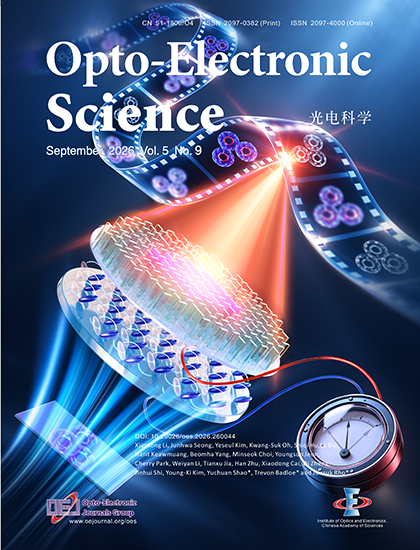
In this work, we demonstrate an electrically switchable imaging system that combines a polarization-multiplexed metalens with a liquid-crystal device. The system provides two bright-field imaging states and one edge-enhanced imaging state, allowing different views of a sample to be obtained without mechanically moving the metalens or digitally processing the images.
The metalens is designed with two orthogonal polarization channels that focus light to the same plane but have different effective apertures. As a result, the channels transmit different ranges of spatial frequencies and produce bright-field images with different resolutions. A voltage-controlled liquid crystal selects the incident polarization, allowing either bright-field channel to be accessed electrically.
The edge-enhanced state is generated by the coherent interference of the two channels. When the incident light is polarized at 45° and the transmitted fields are projected onto the same polarization direction, a designed π-phase difference causes the spatial-frequency components shared by the two channels to interfere destructively. Higher spatial frequencies transmitted by the larger-aperture channel are retained, emphasizing boundaries and fine features in the resulting image. In this way, a third imaging response is synthesized from two encoded polarization channels.
We experimentally demonstrated the system at a wavelength of 635 nm using a resolution target and biological samples, including onion epidermal cells, an earthworm cross-section, and a plant stem section. Switching to the edge-enhanced state made cellular and tissue boundaries more visible directly through the optical system. A comparison device without the designed phase relationship did not reproduce the same edge-enhanced response, supporting the role of interference in generating this imaging state.
This work offers a route towards electrically reconfigurable optical image processing and compact label-free imaging. The demonstrated approach relies on suitable coherent, narrowband illumination and careful matching between the two channels, providing directions for future improvements in bandwidth, efficiency, and robustness.
This research was conducted in collaboration with Professor Junsuk Rho’s team at POSTECH and Professor Yuchuan Shao’s team at the Shanghai Institute of Optics and Fine Mechanics.
이 연구에서는 초저전력 에지 검출을 위한 하이브리드 광전 이미징 시스템을 소개합니다. l=2로 인코딩된 나선형 메타렌즈는 두 번째 차수 에지 정보를 광학적으로 계산하고, 압축 감지 CMOS 이미지 센서는 측정값의 일부만 선택적으로 캡처하여 번거로운 디지털 후처리 없이 고속, 에너지 효율적인 에지 인식 이미징을 가능하게 합니다. 시뮬레이션 결과는 25% 압축률에서 23.87 dB의 최고 신호대잡음비를 보여주었으며, 이는 메타렌즈가 장면을 광학적으로 전처리하고 압축 감지 센서가 전체 센서 데이터의 4분의 1만으로도 고품질 에지 영상을 복원할 수 있음을 의미합니다.
이 논문은 고려대학교 세종캠퍼스 CICS 연구실의 이현근 교수님 연구팀과의 공동 연구입니다:
이 연구에서는 편광 다중화 메타렌즈와 액정 소자를 결합하여 전기적으로 영상 모드를 전환할 수 있는 이미징 시스템을 구현했습니다. 이 시스템은 두 가지 명시야 영상과 한 가지 에지 강화 영상을 제공하며, 메타렌즈를 기계적으로 움직이거나 영상을 디지털 처리하지 않고도 시료의 서로 다른 모습을 관찰할 수 있습니다.
메타렌즈에는 서로 직교하는 두 편광 채널이 설계되어 있습니다. 두 채널은 빛을 같은 초점면에 모으지만 유효 개구 크기가 서로 다릅니다. 따라서 각각 서로 다른 범위의 공간 주파수를 전달하며, 해상도가 다른 명시야 영상을 형성합니다. 전압으로 제어되는 액정은 메타렌즈에 입사하는 빛의 편광을 선택하여 두 명시야 채널을 전기적으로 전환합니다.
에지 강화 영상은 두 채널의 결맞음 간섭을 통해 생성됩니다. 입사광을 45° 선편광으로 설정하고 두 채널을 통과한 빛을 동일한 편광 방향으로 투영하면, 설계된 π의 위상차로 인해 두 채널에 공통으로 전달되는 공간 주파수 성분이 상쇄됩니다. 반면, 더 큰 개구를 가진 채널을 통해 전달되는 높은 공간 주파수 성분은 유지되어 영상에서 경계와 미세 구조가 강조됩니다. 이처럼 두 개의 편광 채널을 이용해 세 번째 영상 응답을 만들어냅니다.
연구팀은 635 nm 파장에서 해상도 타깃과 양파 표피세포, 지렁이 단면, 식물 줄기 단면 등의 생물학적 시료를 사용하여 시스템을 실험적으로 검증했습니다. 에지 강화 모드에서는 별도의 디지털 처리 없이 광학적으로 세포와 조직의 경계를 더욱 뚜렷하게 관찰할 수 있었습니다. 또한 설계된 위상 관계가 없는 비교 소자에서는 동일한 에지 강화 응답이 나타나지 않아, 간섭이 이 영상 모드를 형성하는 데 중요한 역할을 함을 확인했습니다.
이 연구는 전기적으로 재구성 가능한 광학 영상 처리와 소형 무표지 이미징을 위한 가능성을 제시합니다. 현재 구현된 시스템에는 적절한 결맞음과 좁은 대역폭의 조명, 그리고 두 채널 사이의 정밀한 정합이 필요하며, 향후 동작 대역폭, 효율 및 안정성을 개선하기 위한 연구가 기대됩니다.
이 연구는 포항공과대학교 노준석 교수님 연구팀 https://photonics.postech.ac.kr, 중국과학원 상하이광학정밀기계연구소의 Yuchuan Shao 교수님 연구팀 http://www.siom-shao.com 및 공동연구진과 함께 수행되었습니다.